Stigmergy enables complex self organization in
Multicellular Organisms
Organization by stigmergy occurs when individual parts of the system communicate with one another indirectly by modifying and sensing their shared local environment. Termite mounds are a classic example, but cells in our bodies do it and computers do it too.
Cooperation in multicellular systems requires information
sharing. Entities such as cells in a multicellular body, social
insects in a colony, people in societies, or computers in the
Internet do not generally obey commands from some central
controller; they share information by indirect and distributed
paths. Independent entities deposit long-lived cues in external
structures that are subsequently sensed by others. The cues may
be attached to connective tissue with in one body, to surfaces
of shared nests such as termite mounds, or placed in shared
databases or web-sites as the case may be. One illustrative
example is the way chess pieces on a chess board structure the
actions of chess players who interact with each other by
changing the locations of the pieces. Stigmergy structures
provide persistent information that serves to organize the
behavior of otherwise independent entities.
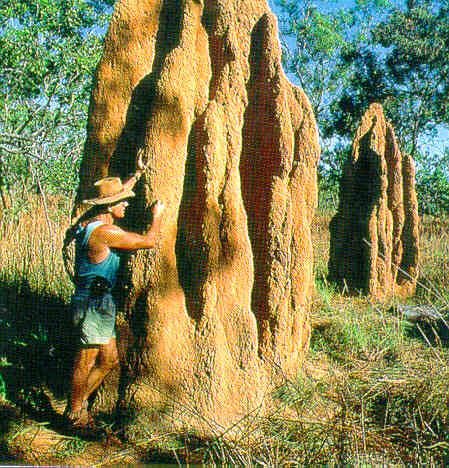
The term stigmergy was coined in the 1950�s [1] to put a name to such communication for social insects and the stigmergy structures that they build, e.g., termite mounds (photo below), ant hills, beehives and even the pheromone-marked ant trails of nomadic social ant species such as army ants. In the last two decades, the idea has been adopted by other disciplines including computer science.
 Although the term stigmergy is relatively new, the phenomenon
itself is ancient. The cytoskeletons within individual cells are
stigmergy structures that help to organize internal cellular
functions. The very bodies of all multicellular organisms are
also stigmergy structures. Cells in a multicellular organism
create a growing body
whose shape and boundaries are defined by a non-living extracellular
matrix created by the cells, e.g., connective tissues and bones.
The cells deposit all sorts of cues, in the form of messenger
molecules, in or on this matrix. The shape of the extracellular
matrix and the signaling molecules attached to it direct the
movement, differentiation, and specialized function of the
cells. So it is fair to think of the bodies of animals and
plants as stigmergy structures akin to very complex termite
mounds.
Although the term stigmergy is relatively new, the phenomenon
itself is ancient. The cytoskeletons within individual cells are
stigmergy structures that help to organize internal cellular
functions. The very bodies of all multicellular organisms are
also stigmergy structures. Cells in a multicellular organism
create a growing body
whose shape and boundaries are defined by a non-living extracellular
matrix created by the cells, e.g., connective tissues and bones.
The cells deposit all sorts of cues, in the form of messenger
molecules, in or on this matrix. The shape of the extracellular
matrix and the signaling molecules attached to it direct the
movement, differentiation, and specialized function of the
cells. So it is fair to think of the bodies of animals and
plants as stigmergy structures akin to very complex termite
mounds.
Brains, the neuron-based information processing systems of
higher multicellular creatures, also depend upon stigmergy in
the form of long-term memories laid down in persistent physical
changes to neurons and synapses. Long-term memory modifies
behavior and behavior in turn modifies memory...that's the
essence of stigmergy.
Computing relies on stigmergy structures in various sorts of digital memory as well --whether in the form of RAM, ROM, FLASH, disk file-systems, huge databases, or the Internet itself.
Stigmergy and "Self"
Stigmergy is intimately related to the somewhat slippery notion of "self." Whatever the philosophical niceties, self is clearly about the organism as a whole rather than just a collection of cells that share the same DNA. That is, self refers to a multicellular organism's body which includes both the cells of the organism and the nonliving extracellular matrix that gives shape and structure to the organism. The extracellular matrix, which is the organism's stigmergy structure, persists for the life of the organism whereas most kinds of cells die and are replaced many times over during the lifespan of the body. In a very real sense, cells are part of the self only insofar as they participate in the self-organizing dance of stigmergy.
Communication via Signals versus Cues
Social insects, cooperating cells, cooperating neurons, and cooperating computers communicate both with signals and cues. Signals are active communication events in real-time whereas cues are information embedded in the stigmergy structure to be read and reread many times. Both are specialized messages in the sense that they mean different things to different specialized receiving cells (or insects or computers). However cues are further specialized by their location -- that is, in addition to the information intrinsic to their molecular form or digital content, there is information inherent in their location in the stigmergy structure. In chess terms, a pawn is just a pawn; the important information is which square on the board it occupies. Because cues have both a message content and a location, cues support more complex kinds of communication than do signals and hence tend to support more complex social organization. As Anderson & McShea report [2], complex ant societies rely more on cues whereas simple ant societies rely more on signals.
As is the case with social insects, cells in multicellular organisms communicate both by signals (messenger molecules moving indiscriminately through blood, lymph or other liquids) and by cues (messenger molecules attached to the extracellular matrix). For example, bone, when stressed, provides location specific cues to osteocytes and other bone cells for its own reshaping to better handle the forces placed upon it. And smooth muscle cells in the walls of blood vessels modulate their contractility according to cues from the extracellular matrix [3]. Not surprisingly, as with social insects, simple multicellular organisms communicate primarily by signals whereas complex multicellular organisms communicate more by cues.
Analogously, computing systems in complex human organization
such as businesses rely on records (cues) deposited in databases
(stigmergy structures), whereas loose organization, e.g.,
file-sharing, can work with real-time peer-to-peer messaging.
Here again, multicellular computing recapitulates biology.
Stigmergy is ever present in complex computing systems
and many novel
Internet stigmergy structures.
More on Evolution
of Computing
[1] See �Self-organization in social insects.� Bonabeau, E., Theraulaz, G., Deneubourg, J.L., Aron, S. & Camazine, S., Trends in Ecology and Evolution, vol 12, pp. 188-193, 1997.
[2] �Individual versus social complexity, with particular reference to ant colonies,� Anderson, C & McShea, D. W. Biol. Rev., vol 76, pp. 211-237, 2001. p. 228
[3] Extracellular matrix controls myosin light chain phosphorylation and cell contractility through modulation of cell shape and cytoskeletal prestress.� Polte, TR, Eichler, GS, Wang, N, & Ingber, DE. Am J Physiol Cell Physiol 286: C518-C528, 2004.
Last revised 10/10/2014